
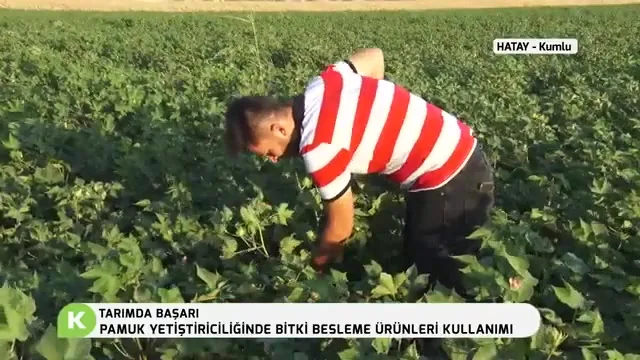
In this episode, AgroTroia's "Success in Agriculture" program was a guest at a cotton field in the Muharremli area of Kumlu, Hatay. With the participation of AgroTroia's Reyhanlı regional dealer, agricultural engineers Reşat and Cemal, along with the village headman and growers, cotton cultivation was discussed from A to Z. This episode, in which a densely and deeply sown field with emergence problems was corrected with sprinkler irrigation and brought to square formation and stem elongation, showed that the correct nutrition program in cotton can compensate even for emergence difficulties.
Soil Preparation and Homogeneous Emergence
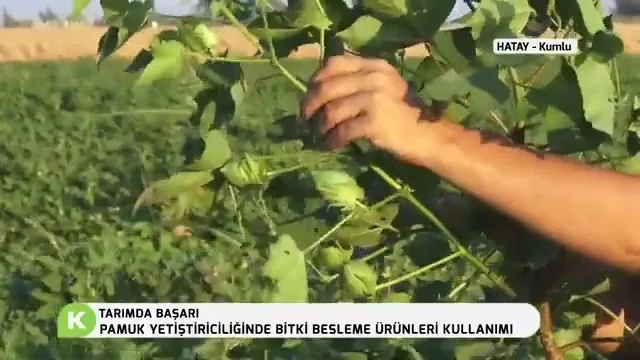
The program recommended preparing the field with deep tillage for cotton planting, and reviving the organic matter activity of the weeds and soil with daylight. Cotton should ideally be sown at a depth of 4 cm; in this field, deep sowing down to 6-7 cm and dense planting had prevented homogeneous emergence. As a solution, instead of drip irrigation, sprinkler irrigation was used to break the crust so the cottonseeds could burst through the cotyledon layer. Then, homogeneous growth was achieved with foliar applications: while the troubled emergence recovered with Copperas, growth, square formation, and boll set were supported with Activo. It was emphasized that great losses occur in cotton that elongates but does not set squares, and that by strictly following the program both growth was regulated and boll and flower opening were increased.
Fertilization and Irrigation
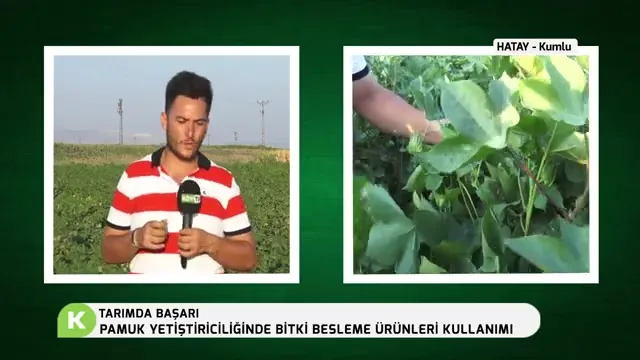
In fertilization, with phosphorus-weighted use at neutral pH, certain rates of DAP or balanced fertilizer per kilogram of cotton were recommended. Because urea increases the green parts too much and makes cotton elongate, the use of ammonium sulfate or calcium nitrate in split doses was advised for most varieties; it was explained that applying in split doses rather than a single high dose increases the fertilizer's efficiency. It was noted that seventy percent of cotton is water and that production is easier in a well-leveled field. Regarding irrigation, it was reported that cotton's first watering comes about 45 days after emergence, signaled by brown freckling on the leaves resembling cocklebur; depending on the flowering, boll formation, and boll-opening periods, generally four irrigations are applied.
Resistance Against Diseases
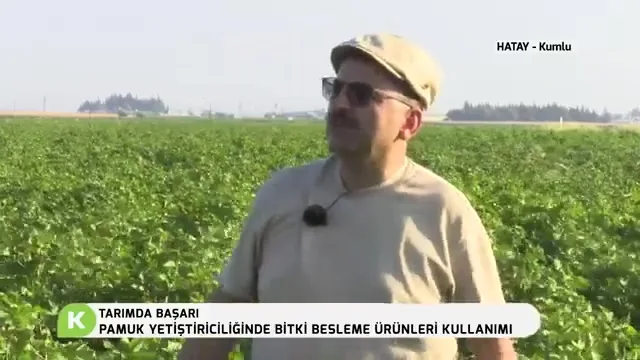
Cotton has few but important diseases. Verticillium wilt starts on the lower leaves and progresses upward, and when not controlled, it causes the plant to rot and leads to serious yield loss. The program explained that, before the disease agents reach the plant, the plant's resistance mechanism is strengthened with Copperas and Activo applications; these products are not used as fungicides but as nutrition that keeps the metabolism strong and prevents the spread of the disease. For seedling rot and crown rot problems seen in the seedling stage, early intervention with Copperas is recommended in fields where seed treatment was not done. In leaf spot disease too, the plant's defense is strengthened with Copperas, protecting boll set.
Fighting Pests
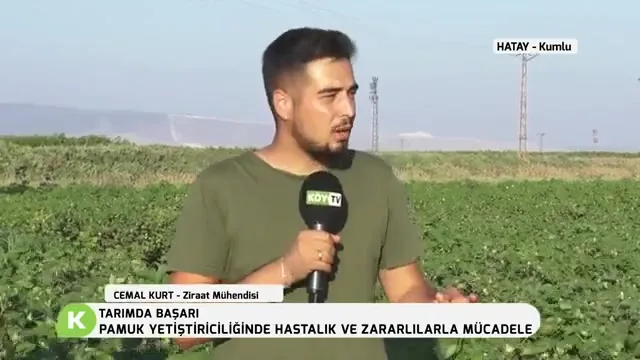
Cotton has a wide variety of pests: aphids (locally also known as zenk), whitefly, thrips, red spider mite, bollworm, pink bollworm, and cutworm are the main threats. Aphids form colonies on the underside of young leaves and multiply rapidly through live birth, crinkling the leaf with their secretions. Thrips cause a silvery color on the underside of the leaf and lead to drop; the red spider mite spins webs on the underside of the leaf, causing spots that turn from yellow to red and boll drop. Bollworm and pink bollworm cause damage by feeding on squares, flowers, and bolls. The most important cultural control measure stood out as destroying plant residues, doing early tillage, and fighting weeds.
Final Application: Maturation and Boll Set
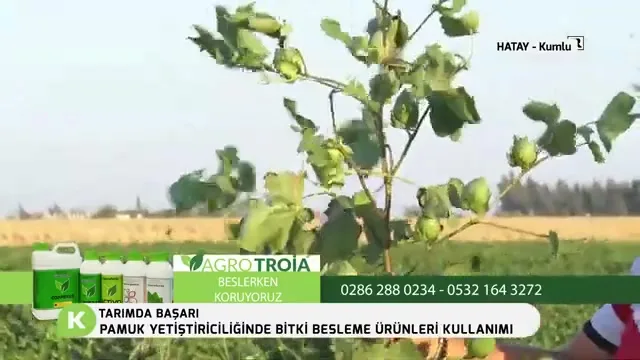
In the final nutrition application, potassium is given without going to excess; it was noted that excess potassium delays maturity and leads to reddening and shedding. Calcium, on the other hand, feeds and swells the boll stalks, preventing square and boll drop. The essence of the program was the message that diseases can be prevented through pioneering and cost-effective applications, without using fungicides.
Featured AgroTroia products in this episode
Copperas - nutrition that strengthens plant resistance against verticillium, seedling rot, and leaf spot
Activo - soil-dissolving nutrition that supports growth, square formation, and boll set
This field in Kumlu showed that even cotton with serious emergence problems can be transformed into a field full of squares and plump bolls through sprinkler irrigation, correct fertilization, and programmed foliar applications. Success in cotton comes as much from keeping the plant's resistance standing in every period as from recognizing disease and pests.
Source: AgroTroia – "Success in Agriculture" program, sponsored by AgroTroia.