
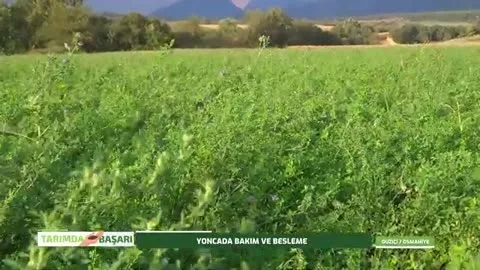
In this episode of AgroTroia's "Success in Agriculture" program, we were at an alfalfa field in Alibozlu village, in the Düziçi district of Osmaniye. This time we showed in alfalfa that AgroTroia, identified with olive, actually works on many crops. In a period when concentrated feed prices have risen in livestock farming, quality alfalfa production is more valuable than ever. We discussed their experiences with field owner İlyas Sokuşlu, young farmer Yusuf Okuşlu, and Mustafa Budak; and with the AgroTroia team and the agricultural engineer, we discussed care, nutrition, and a correct nutrition program in alfalfa.
Alfalfa production and farmer yield in Düziçi
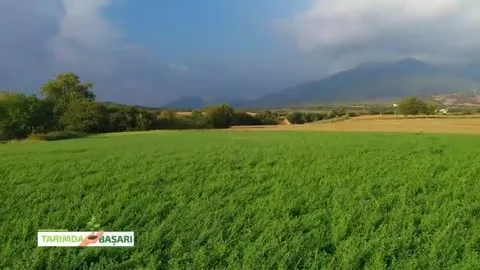
İlyas Sokuşlu, who explained that alfalfa was sown this season on a 10-decare field where corn had previously been planted, said that in its first year he got 130-140 bales from a single cutting, and that if irrigation had been sufficient the yield would have been even higher. Young farmer Yusuf Okuşlu, for his part, noted that while he used to get 5-6 bales per decare before correct nutrition, with AgroTroia products this number rose to 15-16 bales. Mustafa Budak also explained that on his 60 decares of alfalfa he could not exceed 10 bales with classic fertilizers before, but with AgroTroia nutrition products he obtained much higher yield from his 16-decare parcel in every cutting. The farmers' common emphasis was higher yield at lower cost.
Alfalfa cultivation: planting, seed, and soil preparation
The foundation of success in alfalfa comes from a good seedbed and correct planting. While in the Mediterranean climate planting can be done in autumn, in cold regions such as Central Anatolia, spring planting is recommended when the soil temperature rises to 10-12 degrees. First, a deep tillage of 30-40 centimeters, then good soil preparation and weed control with implements such as a disc harrow and a leveler. In planting with a pneumatic seeder, 1.5-2.5 kg per decare is used, and in broadcast planting, 3-5 kg of seed; sowing the seed sparsely increases the plant's tillering and lateral branching. Alfalfa loves calcareous soil and requires about 3-4 kg of pure nitrogen, 13-14 kg of pure phosphorus, and 19-25 kg of pure potassium per decare. Phosphorus is especially important; because when the plant enters winter in a woody structure, it is more resistant to cold.
Yield in alfalfa with the AgroTroia nutrition program
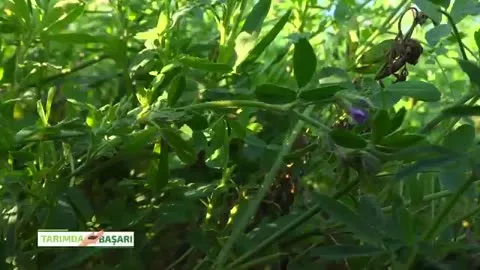
After the alfalfa emerges and shows homogeneous development, the first application of the nutrition program begins. In this application, 100 cc of Activo and 100 cc of Vital are used per decare; in seasonal stresses such as extreme heat or extreme cold, 100 cc of Aminado per decare is added alongside. Aminado increases the plant's stomatal activity and photosynthesis, raising the green parts, dry matter, and crude protein ratio. Unlike classic nitrogen fertilizers, this program shortens the internodes; this means more flowers, more leaves, and therefore more bales. When only nitrogen is given, the plant grows only upright, enters winter weak, and burning, yellowing, and deaths can be seen in the cold; this lowers the number of bales and increases costs.
Fighting the alfalfa weevil
The most important pest of alfalfa is the alfalfa weevil. It produces only one generation per year and, because it does not like heat, it is active until the first-second week of May, until the soil warms to 20 degrees. In chemical control, malathion active-ingredient pesticides can be used. A practical method for growers who do not want to use pesticides is also as follows: if, after alfalfa is cut in May, no irrigation is done for a week to ten days, the weevil that descends into the soil is eliminated on its own in the excessively heated soil. This both reduces the pest and saves on water cost; however, since delaying irrigation can harm the alfalfa, timing requires care.
Fighting dodder and weeds

In alfalfa, alongside weeds such as field bindweed and cockscomb, the main pest is dodder (cuscuta), also called sheep's-yarn among the public. With a thin, yellow, wire-like creeping stem, it climbs the alfalfa and directly affects the green parts in the area where it is found. Since an effective chemical herbicide is not common, the best method is cultural control: crop rotation and rotation. In fields where dodder appears, grazing animals should be stopped; the infested area, including the alfalfa, should be uprooted and destroyed elsewhere, and the cleared areas can be replanted locally.
Featured AgroTroia products in this episode
- Activo — the basic nutrition product used at 100 cc per decare in the first application in alfalfa.
- Aminado — an amino acid supplement that supports stomatal activity and photosynthesis, added at 100 cc per decare in seasonal stress.
As the farmers in this episode in Düziçi, Osmaniye clearly demonstrated, correct care and balanced nutrition significantly increase both the number of cuttings and the bale yield per decare in alfalfa. Higher yield with less fertilizer benefits both the grower's pocket and the soil.
Source: AgroTroia – "Success in Agriculture" program, sponsored by AgroTroia.