
In this episode, AgroTroia's "Success in Agriculture" program was a guest at Lütfi Bey's walnut orchard in Pazarcık, Kahramanmaraş. Together with AgroTroia board member Umut Dönmez, regional dealer Duran Bey, and agricultural engineers, walnut care, nutrition, and the management of diseases and pests were addressed. The story of a grower who came to farming later in life and established an orchard by clearing rocky, stony land showed just how decisive patience and the correct walnut nutrition program can be in walnut cultivation.
Orchard Establishment and Leader-Based Pruning
The grower explained that they had let the saplings grow like shrubs and that pruning and shaping were neglected in the early years. He shared that, although a walnut system should be established based on a central leader, an inexperienced pruner cut all the leaders, so they struggled for years to develop a new leader. The program emphasized that pruning should not be done as one would prune an apple tree, that the sapling should be left to strengthen its roots in the early years, and that the leader branch should be protected. It was also noted that walnut is now recommended to be crowned at two meters; crowning close to the ground both complicates mechanical operations and increases disease and gall mite pressure. Removing branches that compete with the leader and thinning the thin branches in the middle make care easier.
Fighting Bacterial Blight and Anthracnose
One of the most critical diseases in walnut is bacterial blight; it starts on the leaf and spreads to the fruit, and at advanced stages it causes cracks and exudates on the trunk, leading to the dieback of the tree. The foundation of the fight is trunk application: measured amounts of Activo and phosphoric acid are added to a backpack sprayer and the trunks are treated; here Activo acts as a carrier, transporting the phosphite ion into the vascular bundles, cleaning the bundles and improving the tree's nutrient exchange. During the flowering period, applications with Activo and gibberellic acid group products are made, and the fight against anthracnose is carried out together with bacterial blight. Timely insecticide applications are also recommended for aphids, red spider mite, and codling moth.
Post-Harvest Nutrition and Protection from Sunscald
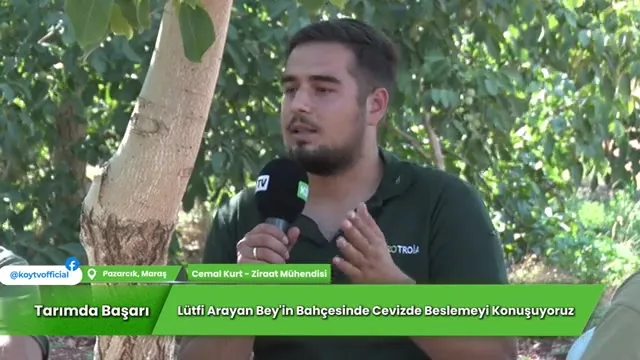
The program emphasized that the real work begins after harvest. As the first application, Copperas is used to seal and disinfect the wounds left from harvest; alongside it, the exhausted tree and fruit buds are fed with phosphoric acid. With a boron-zinc Nitrozinc application, next year's fruit buds ripen better and the tree is put into dormancy homogeneously; this ensures maximum pollination during the flowering period. At leaf fall, as a winter application, one liter of Copperas per hundred liters cleans up fungal pathogens. Against sunscald, an aloe vera-based supplement and kaolin clay are recommended, and the importance of this protection in hot regions was highlighted. During the kernel-filling period, by using Fors through drip irrigation, the rate is reduced from 20-25 kg of potassium fertilizer down to 2-3 kg, both significantly lowering costs and achieving a high kernel-filling ratio.
Analysis, Soil, and Cost
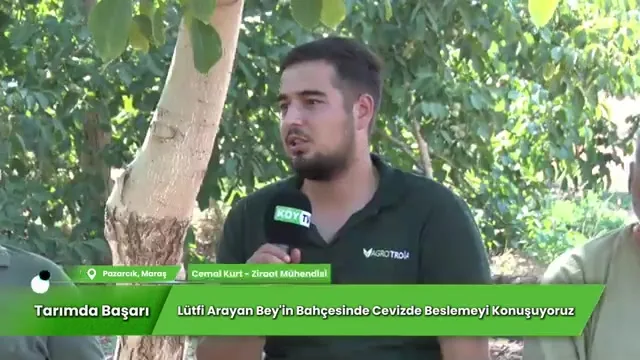
Leaf and soil analysis is essential for fertilizer selection; even if it cannot be done every year, analysis at least once every two to three years clarifies what is present in the soil and which fertilizer should be applied. In calcareous soils, emphasizing sulfur-based fertilizers is recommended. For this particular orchard, the engineer reported that it had a significant phytophthora history, that the wounds had begun to close with trunk application, and that fruit set and caliber were good; however, there was cold damage. The grower, for his part, expressed his frustration over market and price problems and over imports putting pressure on domestic producers, despite all the care and nutrition he had applied.
Featured AgroTroia products in this episode
Copperas - post-harvest wound sealing, winter cleanup, and resistance to fungal diseases
Activo - carrier in trunk application, nutrition that cleans the vascular bundles
Nitrozinc - ripening of fruit buds and homogeneous dormancy with boron-zinc
Fors - nutrition that lowers cost and increases kernel filling during the filling period
This orchard in Pazarcık shows how an enthusiasm that started on rocky land turned into a healthy and productive orchard through correct pruning, regular fighting against bacterial blight and anthracnose, and programmed nutrition starting right after harvest. Success in walnut comes from giving the tree exactly the element it needs in each period, right on time.
Source: AgroTroia – "Success in Agriculture" program, sponsored by AgroTroia.